
Hey friend!
So, I’ve been in the organizing industry since 2017 and have worked with multiple clients diagnosed with Attention Deficit Hyperactivity Disorder (ADHD). One powerful truth I constantly encounter is that organization becomes much easier when we stop treating ADHD like a character flaw and start recognizing it as a difference in brain function.

ADHD is not just a description for someone getting easily distracted or losing focus. It’s a neurological condition where certain parts of the brain may be smaller or less active, which causes neurotransmitter pathways to function differently. It is biological and not a result of poor parenting or behavioral choices.
Most significantly, ADHD impacts our Executive Function Skills. Skills like planning, prioritizing, initiating tasks, regulating attention and emotion, and managing time. The very same skills that would help someone get organized and stay that way. This means that despite good intentions, an individual diagnosed with ADHD can struggle to initiate tasks, experience overwhelm quicker when there’s too many steps to a task or have difficulty to feel any urgency to follow through with a task.
For individuals affected by ADHD, the lack of desire to be organized isn’t the challenge. The obstacle is that many conventional systems that are accessible didn’t consider ADHD brains when they were designed. Stimulation, processing modalities (the way an individual processes information) , and motivation issues are still not typically considered.
The issue is often not the person. It is the system.
As I help clients through their clutter, I notice how difficult organizing can become, so I encourage them to recognize that ADHD boils down to different brain wiring rather than a moral failure or a character flaw. When we give space for compassion, experimentation, and curiosity, the opportunity for change grows.
On that note, I want to share with you the common organizing dilemmas I see in ADHD households and offer you practical strategies you can try! I am aware that there’s no one-size-fits-all system but these small collection of suggestions have worked for real clients so I hope it inspires you to find the appropriate system for yourself!
The “Floordrobe”
This is the pile of clothes that you have on the floor of your bedroom or any space in your home. It may be a mix of dirty, clean and ‘kind of’ clean clothes. Sometimes they are contained in a basket, but typically never put away into a closet or dresser.
Now, for the user, some parts of it may make sense because it’s a system, but more often than not, it’s not a system that’s working well.
What Might Help:
I understand that a traditional closet system might not work because of the multiple steps it implies, so here are options that I’ve seen work in my clients’ spaces
- Use a laundry bin rack. This does require a bit of DIY in the beginning but once done, the laundry-to-closet friction is reduced by a lot. My client converted the bottom part of their closet into laundry baskets with big labels on them to help with memory. One is strictly for scrubs, one is for bottoms, one is for t-shirts, and one is for underwear and socks. They don’t enjoy folding, but like the idea of still having a place for clothes. The laundry basket not only allows no folding, but it also reduces visual clutter.

- Using primarily hangers. Another client prefers hanging all her clothes, so we opted to change her hangers to ultra-thin velvet hangers to maximize space. There are some clothes she is okay with being folded, so making a definite rule on what hangs and what doesn’t is key to reducing constant decision making. In her case, “house” clothes, clothes that are only worn at home, fall into the folding category which are stored in the dresser in her bedroom, while “outdoor” clothes, like work clothes, belong in the closet.
- Using coat racks. In my own home, we installed coat racks by our bed side, one for me and one for my husband. Clothes we want to wear again go into this rack and, to make sure it doesn’t get loaded with too many clothes, we do a clothes check on laundry day to rotate clothing. This gets the pile off the floor and reduces visual clutter.
Doom Piles
I recently learned that DOOM stands for Don’t Organize, Only Move and my mind was blown. This whole time I just thought they were called doom piles because they were doomed to never be touched again (which is the case for most of my clients), but the real definition makes more sense! Doom piles are mixed collections of items that represent delayed decisions. These are very common for individuals affected by ADHD as decision fatigue makes it more impossible to get any traction on making categories. The decision tangent is also complex, you have to ask yourself several questions for one small thing like, “Where does this go?”, “Do I need this?”, Why am I keeping this?” Multiply that by 10 items and your brain definitely taps out. Another factor at play with these piles is procrastination. From my experience, if you see one doom pile, there will be more doom piles laying around the house, so the tasks just start feeling too big.

What Might Help:
- Embrace progress over perfection. Instead of viewing it as a whole project to go through all doom piles, start with one. You can even break that pile into 15 minutes at a time.
- Employ help and fun. One of my clients plays a murder podcast while I body double with her as she goes through her doom pile. She listens to the podcast while sorting through piles. I then assist her by being her “runner” instead of her getting up herself. Several things are at play here. The first is body doubling; with my presence and assistance, she is able to put all her focus into the pile in front of her. Because she isn’t the one to move the items, her chances of getting distracted are reduced as well. Another element here is making the activity more engaging by playing her favorite podcast. She partnered a mundane task with something she enjoys.
- Select categories while organizing. By limiting your categories for your belongings, you reduce the decisions and choices you need to make. In one of my in home sessions, my client and I went through the entire house, room by room and made decisions on what she thinks belongs there before moving anything. We also named the activities she pictures herself doing in each room. We developed a visual map together. This helped with creating categories and placement when she was going through the doom piles. If the item doesn’t fall into any of those created categories, she had an easier time letting them go. Limiting and creating boundaries for your spaces is crucial so it doesn’t become a bigger task.
Paperwork and incoming mail
In my experience, paper is one of the most common dilemmas my clients impacted by ADHD face. I get it; it requires multiple steps with no dopamine hit, it’s such a small item, yet you have to constantly switch and analyze what’s on each. Sorting paper requires you to remember information that isn’t exciting or relevant to your day-to-day, and it requires you to sit still and decide whether to take action or just file the document. Since all of these factors make the task incredibly unattractive, it feels easy to avoid, which then results in piles of paper that now may make you feel unsatisfied with your space or, worse, get you in trouble, such as fines for delayed payment or legal issues for not responding sooner.
What Might Help:
- Dedicating a physical spot will keep things visible. For example, a client of mine does a lot of work on the dining table, so she decided to have a bin for incoming mail where she usually works. This is accompanied by a reminder/alarm on her phone to go through mail right around the time she stops working.
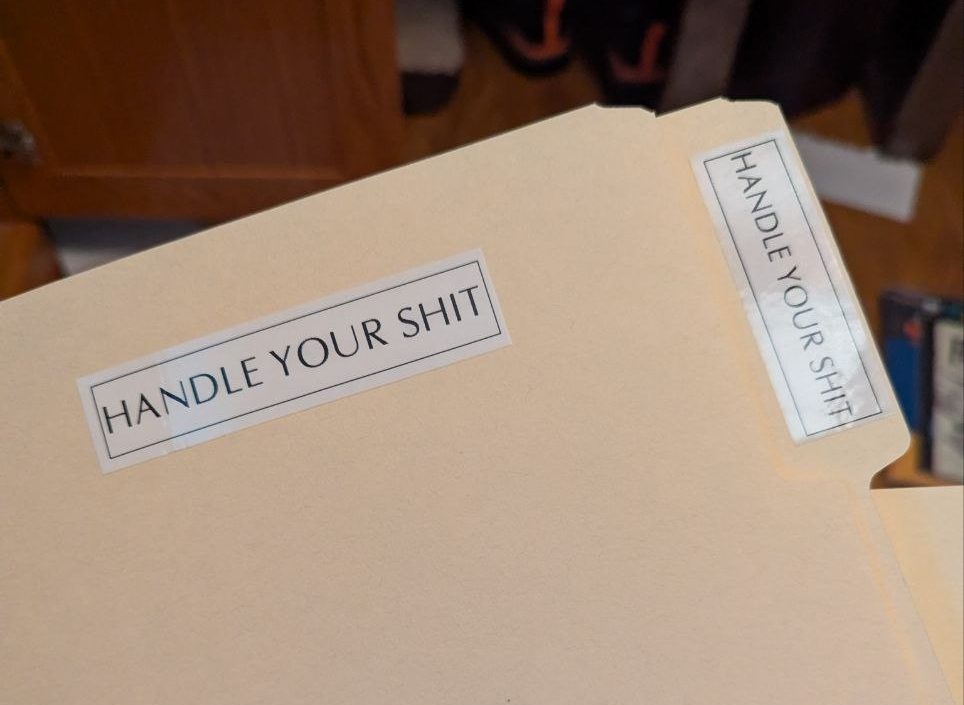
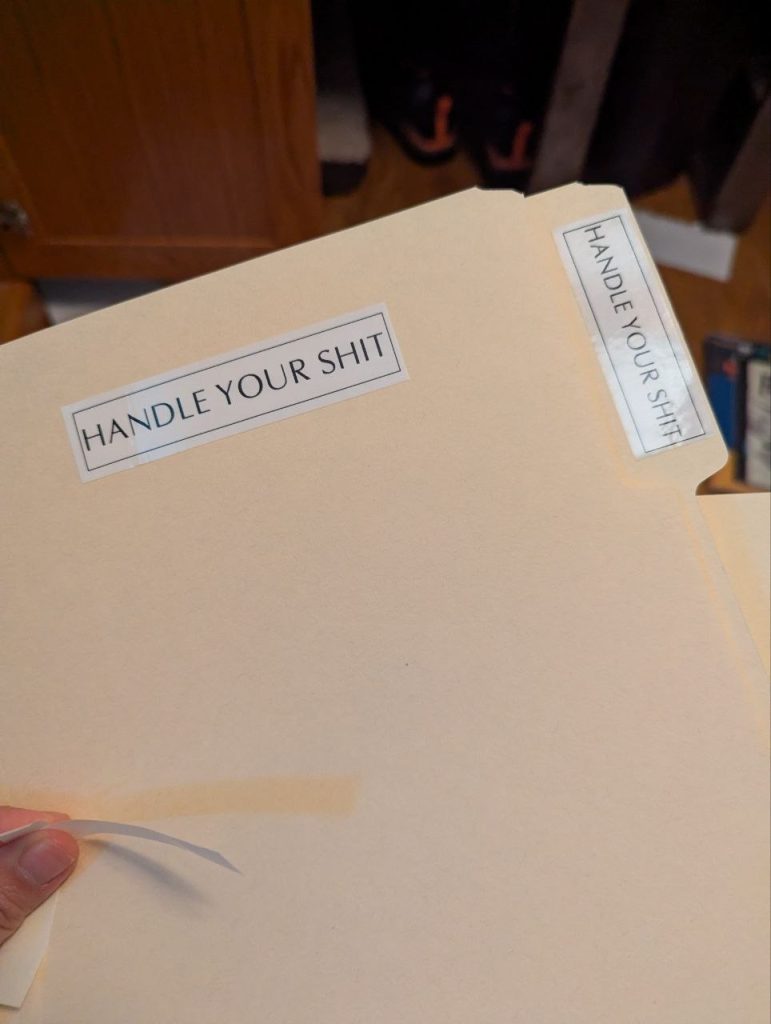
- Make it humorous and silly for a small dopamine/endorphin hit. One of my clients came up with a “Handle Your Shit” Folder. This is a file folder for paper that needs attention or an action to be done. She said that every time she sees the name, she giggles, but it also lights a fire under her.
- Have a Mail Sorting Party. Organizing doesn’t have to be a solo event, in fact, it’s encouraged to make it into a social one! One of my clients struggles with paperwork, but loves the idea of holding space to get through it together. She prepares snacks and drinks for one or two of her friends each month and they bring together their paper piles. The novelty of it being a “party” makes a boring task be more entertaining and the body doubling that happens between all individuals provides accountability that individuals with ADHD tend to benefit from.
- Start small, like really small. Perfectionism takes away opportunity for progress. I know it feels silly to break things down into smaller tasks, like writing your name on a form you have been dreading to fill out, but it does help the brain to feel less pressure. Once you get it going, it’s easier to fill out the next part of the form.
My hope in sharing these recommendations with you is to normalize funky, funny and out of the box solutions that work for neurodivergent brains. From experience, this is what has been the most successful. You are unique. Your brain is unique. It’s okay if your organizing solutions are not what you see on Pinterest or Instagram.
And if you find yourself needing a little more support along the way, I hope this reminds you that there truly is a lid for every pot. Sometimes, it just takes the right kind of support to help you find what fits. May I be one of the people who helps you find the lid to your pot.